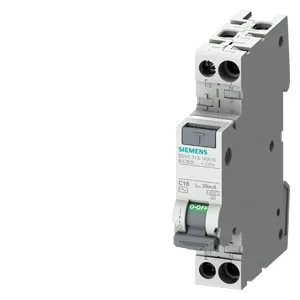
It's rated 10 A with a B-curve overcurrent characteristic and 30 mA Type A residual current protection, breaking capacity 4.5 kA per EN 60898. This is the part you spec into a final subcircuit where both overcurrent and earth-fault protection are needed in one DIN-rail slot, saving a module width versus separate MCB + RCCD.
The B-curve means the magnetic trip operates at 3 to 5 times rated current — so 30 to 50 A for this 10 A unit. The 30 mA residual trip covers basic additional protection against direct contact; Type A detects pulsating DC fault currents, which matters for circuits with single-phase rectifiers, electronic loads, or variable-speed drives downstream. In a domestic or light commercial distribution board with a typical upstream transformer impedance, 4.5 kA is adequate for most final circuits. If your fault level exceeds that, you need a higher-rated upstream device or a current-limiting MCB upstream to coordinate. The 1P+N design switches the line pole only; the neutral is switched but not protected. That's standard for single-phase final circuits where the neutral is not overload-protected. The module occupies one 18 mm modular unit, so it fits any DIN-rail enclosure with standard 18 mm pitch. Thermal derating is published: 10 A at 30 °C ambient, dropping to 9.4 A at 40 °C, 8.8 A at 45 °C, and 7.4 A at 70 °C (–). If your distribution board runs hot — say above 40 °C in a sealed enclosure — size the circuit load to the derated figure, not the 30 °C nameplate.
This RCBO belongs in the final distribution board of a commercial or light industrial installation — protecting a single-phase socket circuit, lighting subcircuit, or small equipment feed. The SENTRON series is Siemens' standard for panelboard protection; the 18 mm width and 1P+N format make it a direct fit for any DIN-rail enclosure. IP20 rating means it's for dry indoor use inside a distribution board with connected conductors — not for wet or outdoor locations without an outer enclosure.