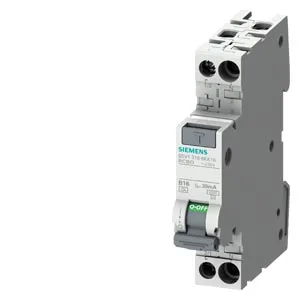
It's an instantaneous design — no intentional time delay on the residual current element — so it trips on earth faults without waiting, which matters when you're protecting a circuit that needs fast disconnection for personnel safety or sensitive equipment. Either way, it's sized for the 2 A load — not a main breaker, but a branch-circuit protector for a small motor starter, a control transformer primary, or a lighting circuit.
At 40 °C it's 1.9 A, at 50 °C it's 1.8 A, and at 70 °C it's 1.6 A. If this RCBO sits in a crowded enclosure next to contactors or a power supply that pushes the internal temperature to 50 °C, you're effectively limited to 1.8 A continuous — plan the load accordingly. The derating curve is linear enough to interpolate for intermediate temperatures. Width is 18 mm (1 modular unit), depth 77 mm, height 90 mm, installation depth 70 mm. That's a single-pole width on a standard DIN rail — it fits in any 18 mm slot. Mounting position is any orientation, so it works in horizontal or vertical busbar arrangements. Supply can come from top or bottom, which simplifies wiring when the panel layout forces a reverse feed. Degree of pollution 2 and overvoltage category III are standard for fixed-installation distribution panels.
Rated insulation voltage (Ui) is 253 V, surge voltage resistance 4 kV. Operating frequency is 50 Hz only. For a 2 A circuit, that means magnetic trip between 10 A and 20 A. If your load has a high inrush (like a large capacitor bank or a welding transformer), you'd want a D curve; if it's purely resistive, a B curve would give tighter protection. This C curve is a good middle ground for general-purpose branch circuits.