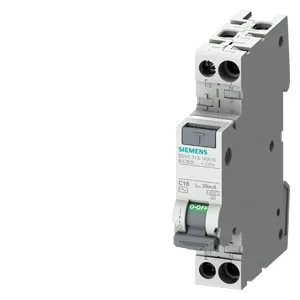
It combines ground-fault and overcurrent protection in a single module, rated for 4.5 kA breaking capacity with a 300 mA type AC residual-current trip and a C2 characteristic curve. That 300 mA sensitivity is typical for general-purpose socket circuits where a lower 30 mA threshold isn't required by code, and the type AC designation means it trips on sinusoidal AC residual currents only.
It'll clear a bolted fault at the distribution board, but if your service entrance has a higher prospective fault current (say, 6 kA or 10 kA), you need upstream current-limiting protection — typically a gG fuse or a higher-rated MCB. The 300 mA residual-current sensitivity is for fire protection rather than personal shock protection; code often mandates 30 mA for socket circuits accessible to the public. The C2 curve is a moderate magnetic-trip threshold — it holds through the inrush of a small pump or compressor motor without tripping, but still opens fast on a hard short. If you're protecting a purely resistive load or a long cable run with high leakage, a B-curve might be a better fit; for higher inrush, a D-curve. This sits in the middle.