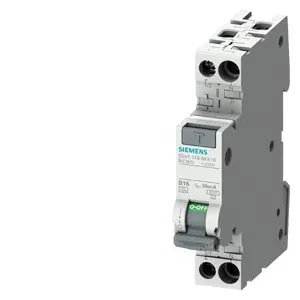
It protects against both overload/short-circuit and earth leakage in one unit, saving a DIN-rail slot over separate devices. The residual-current element is type AC, meaning it detects sinusoidal AC earth faults only. For a line with pulsed DC or mixed-frequency fault currents (variable-speed drives, UPS-fed circuits), you would need a type A or F device instead.
The 5SV1616-0KK06 carries two breaking-capacity ratings: 6 kA per EN 60898 (the standard for household-type MCBs) and 35 kA per IEC 60947-2 (the industrial standard for circuit-breakers). The 35 kA figure applies when the device is used as an industrial breaker per 60947-2, giving headroom for high-fault installations. The 6 kA rating governs most residential and light-commercial panels. That matters for selectivity coordination with upstream breakers. Compared to the 5SY6006-7 (a standard MCB without RCD), the 5SV1616-0KK06 adds the residual-current module in the same footprint. If your panel was wired for a 5SY6006-7, this RCBO drops into the same 18 mm slot and same busbar arrangement — no rewiring needed for the phase connection, but the neutral must be routed through the RCBO for the RCD to work.
Temperature derating — real-world current capacity
Above that, the device derates: 5.64 A at 40 °C, 5.28 A at 50 °C, and down to 4.44 A at 70 °C. If the panel runs warm (enclosed DIN-rail assembly, adjacent heat sources), size the load to the derated value at your ambient — not the 30 °C number. That simplifies panel layout when busbar routing forces a reverse feed. The 7 mm difference accounts for the front toggle and terminal screws. Verify the enclosure depth clears 77 mm plus wiring bend radius.