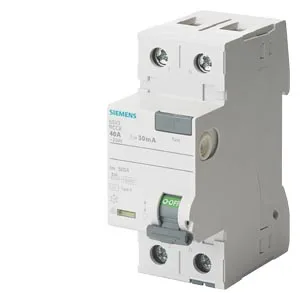
The short-time delayed switching function (marked as short-time delayed in the design) gives it selectivity against transient nuisance trips — it holds through brief inrush or surge events that would trip a standard instantaneous RCCB. The current derating curve is the real selection gate here: 80 A at 40 °C drops to 77.87 A at 45 °C, 74.77 A at 50 °C, 70.26 A at 55 °C, 64.32 A at 60 °C, 56.96 A at 65 °C, and 48.19 A at 70 °C. The 10 kA SCCR at 230 V AC means it's rated for installation at the service entrance or sub-distribution board where available fault current is moderate; for higher fault levels you'd need a current-limiting upstream breaker.
The 70 mm installation depth and 36 mm width (2 width units) mean it occupies the same slot as a standard 2-pole MCB, so it drops into an existing distribution board without re-spacing. Conductor cross-section accepts 0.75 to 35 mm² solid or stranded — that covers everything from control wiring (1.5 mm²) up to a 35 mm² feeder tail. Supply connection can be top or bottom, which simplifies busbar routing in a crowded panel.
The Type F fault current classification is per IEC/EN 62423, covering circuits with variable-speed drives, washing machines, and other electronics that generate mixed-frequency leakage. The short-time delayed characteristic (3 kA surge current resistance, 110 000 A²·s I²t withstand) gives coordination with surge protective devices and selectivity with downstream RCCBs. Silicon-free construction is specified, which matters for applications where silicone outgassing can contaminate contacts or optics.