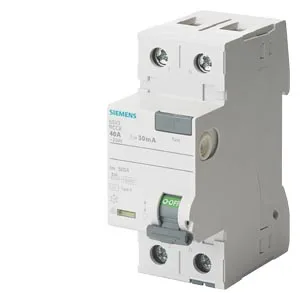
RCCB for the panel — 80 A Type A, instantaneous trip
The Siemens 5SV3417-6KL is a 2-pole residual current circuit breaker (RCCB) from the SENTRON 5SV3 series, rated 80 A at 40 °C on a 230/400 V AC supply. Type A fault-current detection means it catches both sinusoidal AC and pulsating DC residual currents — the standard choice for circuits with single-phase rectifiers, switched-mode supplies, or variable-speed drives downstream. Instantaneous trip, no intentional delay, so it clears ground faults fast on circuits where selectivity isn't required. Rated short-circuit withstand is 10 kA (per IEC 61008), and the I²t let-through is 110 000 A²s — enough to coordinate with a 10 kA upstream MCB without the RCCB rupturing on a bolted fault. Surge-current resistance is 1 kA, so it won't nuisance-trip on capacitor inrush or a nearby lightning surge. Mounts on DIN rail (REG profile), occupies 2 width units (36 mm), and accepts conductors from 0.75 to 35 mm² solid or stranded — covers the full range from control wiring up to the incoming tails.
Thermal derating — what 80 A means in a hot panel
Inside a crowded enclosure or near a curing press, ambient climbs. At 45 °C the continuous current drops to 77.87 A; at 50 °C it's 74.77 A; at 55 °C it's 70.26 A; at 60 °C it's 64.32 A; at 65 °C it's 56.96 A; at 70 °C it's 48.19 A. If the panel ambient runs 55 °C, size the load at 70 A max or step up to the next frame. The storage range is -40 to +75 °C — the device can sit in a hot warehouse or cold truck without damage.
Integration — DIN rail, IP20, any position
Mounting position is unrestricted — horizontal, vertical, or upside-down — which helps in tight gland-plate layouts. The IP20 rating applies only when the distribution board is installed with conductors connected; the device itself is finger- and back-of-hand safe per the touch-safe terminals.