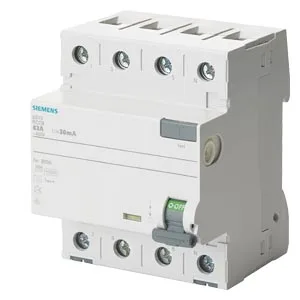
The "selective" designation means it's designed with a deliberate time delay — it holds through short-duration earth faults so the downstream RCCB trips first, keeping the rest of the sub-distribution board live. That's your coordination play: you install this at the feeder or main incomer position, and standard RCCBs downstream handle the branch faults. Type A detection covers sinusoidal AC and pulsating DC residual currents, which is the minimum for circuits with single-phase rectifiers or switching power supplies.
DIN rail fit and thermal derating
Mounting position is any orientation, so it fits tight corner spots in the panel. Thermal derating is flat at 63 A from 40 °C up through 60 °C ambient; at 65 °C it drops to 57.35 A, and at 70 °C to 48.8 A. That means in a well-ventilated panel at typical 40–50 °C you get full rated current with no headroom loss. Supply connection can be top or bottom feed — no orientation restriction on the line/load side.
Compliance and standards coverage
Rated according to IEC 61008-1 with a 0.8 kA conditional rating under that standard, and also carries an EN 60898 rating at 0.8 kA. Overvoltage category III suits fixed installation in distribution boards. Surge current resistance is rated at 5 kA, and the permissible let-through energy is 7 100 kA — both figures for coordination studies if you're doing a full selective arc-flash analysis.