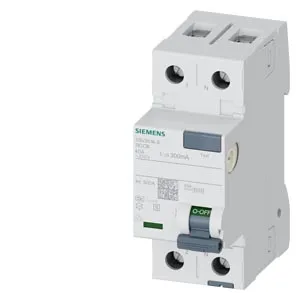
Type A sensitivity means it catches pulsating DC faults on top of standard AC sine-wave leakage — common on VFD-fed motors, switched-mode supplies, and modern electronics where half-wave rectification happens. The selective (time-delayed) design lets it ride through short-duration earth faults downstream so the branch RCCB clears first, keeping the main feed alive. That coordination is what makes it a fit for distribution sub-mains or feeder circuits where nuisance tripping of the whole panel is not acceptable.
Rated at 40 A at 40 °C, but the thermal derating curve is published: 38.1 A at 45 °C, 35.59 A at 50 °C, dropping to 17.6 A at 70 °C. The short-circuit current rating is 10 kA per IEC 61008-1 and 0.5 kA per EN 60898; that 10 kA figure governs the upstream fuse or MCB selection for fault coordination. Depth is 70 mm — check gland-plate clearance if the panel back wall is tight. IP20 with conductors connected, so it is panel-internal only; no washdown exposure.