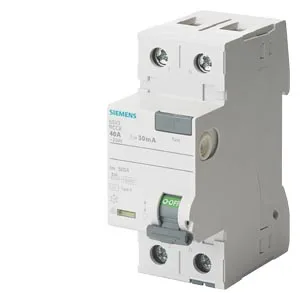
The Type F designation means it detects sinusoidal AC residual currents plus pulsed DC and composite frequencies up to 1 kHz — covering variable-speed drives, inverters, and other non-sinusoidal loads that a standard Type A would miss. The selective design (time-delayed) lets it ride through short-duration earth faults so the downstream RCCB trips first, keeping upstream circuits live — essential for staged selectivity in a distribution board.
The 80 A rating holds at 40 °C ambient; above that, derate per the published curve — 77.87 A at 45 °C, 74.77 A at 50 °C, stepping down to 48.2 A at 70 °C. The 300 mA trip threshold is typical for fire protection or equipment-level earth leakage where nuisance tripping from capacitive leakage (long cable runs, filter caps) must be avoided.
IP20 applies once installed in a distribution board with conductors connected — not rated for open-panel or washdown environments. Silicon-free construction avoids outgassing concerns in sealed enclosures.