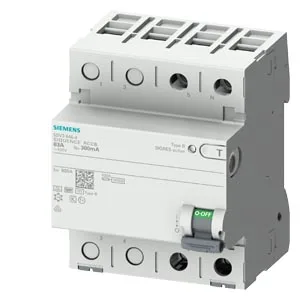
The Siemens SENTRON 5SV3621-4 is a 2-pole residual current operated circuit breaker (RCCB) rated 16 A with 300 mA sensitivity, Type B characteristic, short-time delayed, for 230 V AC supply. It snaps onto a DIN rail (REG) and occupies 4 modular width units at 60 mm grid spacing — standard panel cutout, no surprises for the wireman filling a row.
What the ratings mean for fit
Type B detection covers AC, pulsating DC, and smooth DC residual currents up to 1 kHz — the right choice when variable-speed drives, UPS systems, or EV chargers are downstream and a standard Type A would miss the DC component. The short-time delayed design (SIGRES function) means it withstands brief surge currents without nuisance tripping, so it coordinates with upstream devices in a selectivity scheme. 10 kA short-circuit current rating (SCCR) per IEC 61008-1 (0.8 kA rated conditional) tells the panel builder this device safely clears a fault up to that level without welding contacts or cascading damage — critical for the SCCR label on the distribution board. Supply voltage for the test circuit spans 70–250 V AC, 50/60 Hz, meaning the internal test button and the SIGRES function stay operational across a wide mains range. Power loss per pole is 0.5 W at rated current in hot operating state — negligible for thermal budgeting inside a crowded enclosure, but worth noting if the panel runs near its 45 °C ambient ceiling.
Deployment context
Mounts in any position on a DIN rail; installation depth is 70 mm, matching the overall depth. IP20 with connected conductors — standard for enclosed distribution boards, not for wet areas. The top or bottom supply feed (top preferred when the SIGRES function must remain active in the switched-off state) gives the installer flexibility when busbar routing is tight. Silicon-free construction suits environments where outgassing would contaminate coatings or optics.
