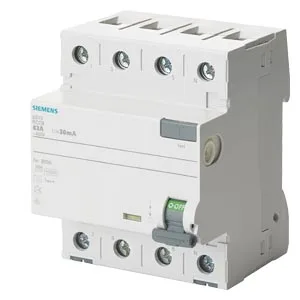
The 10 kA short-circuit current rating (SCCR) per IEC 61008-1 means it can interrupt a fault up to that level without upstream fuses needing to clear first, as long as the supply voltage stays within the 230/400 V AC range at 50/60 Hz.
Type F detection covers residual currents up to 1 kHz and smooth DC above 6 mA — the kind a single-phase VFD or washing-machine inverter pushes back onto the line. A standard Type A RCCB would either not trip or trip late on those waveforms. The short-time delayed design (0.8 kA rated conditional short-circuit current per IEC 61008-1) lets it ride through brief surge currents up to 3 kA without nuisance tripping, which matters when the panel feeds motor starters or capacitor banks that draw inrush. The 300 mA trip threshold is a personnel-protection level in many industrial standards (IEC 60364), but it is also high enough to avoid nuisance trips on long cable runs with natural leakage. If your line requires 30 mA for wet-location or medical circuits, this is not that part — step down to the 5SV3644-1 or similar.
DIN-rail (REG) snap-on, any mounting position. Depth is 70 mm, width 72 mm (4 x 18 mm), height 90 mm. Silicon-free construction is a plus if the panel shares space with potting or conformal-coating operations where silicone outgassing causes adhesion failures.