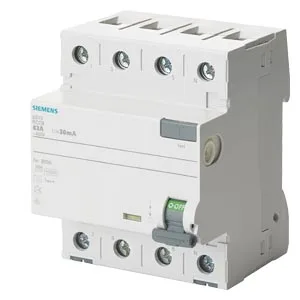
It is a selective (S-type) device, meaning it incorporates a short time delay to achieve coordination with downstream RCCBs — only the faulted branch trips, keeping healthy circuits live.
That is unusual for a thermal-magnetic device; here it is a pure residual-current trip, so the 40 A is the maximum continuous load current the main contacts can carry, not a thermal trip threshold.
Selective (S-type) design — coordination logic
The S-type designation means this RCCB is deliberately delayed (typically 40–150 ms) so that a downstream standard RCCB clears a ground fault first. In a distribution board feeding multiple sub-panels or machine circuits, the selective RCCB at the incomer prevents a single branch fault from blacking out the entire board. The surge current withstand is 5 kA, and the I²t rating is 58 000 A²s — both figures that matter when sizing upstream protection.