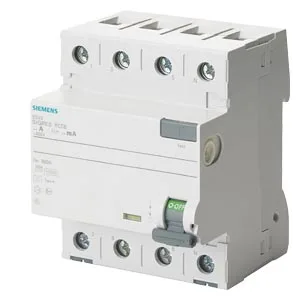
The Siemens SENTRON 5SV3646-8KK12 is a 4-pole residual-current circuit breaker (RCCB) with a selective (time-delayed) design, rated 63 A at 40 °C and tripping on a 300 mA residual current of Type A — meaning it detects sinusoidal AC and pulsating DC fault currents, which covers most modern electronic loads. Selective construction means it holds during a downstream fault long enough for the branch RCCB to clear, so only the faulted circuit drops out; the upstream supply stays on the bus. That coordination matters in a distribution panel feeding multiple sub-panels or motor control centres where a nuisance trip on the main would take down the whole unit. Short-circuit withstand is 10 kA per IEC 61008-1, and it carries an EN 60898 rated conditional short-circuit capacity of 0.8 kA — the standard for RCCBs coordinated with an upstream overcurrent device.
Snaps onto DIN rail (REG profile). Depth is 70 mm; installation depth matches at 70 mm. Mounting position is any orientation. Rated current holds at 63 A from 40 °C through 60 °C; at 65 °C it derates to 57.35 A, and at 70 °C to 48.84 A.
The 5SV3646-8KK12 carries a current-production lifecycle stage.
The permissible let-through energy (I²t) is listed at 110 000 A²·s. That number governs the thermal stress the RCCB can pass to downstream conductors during a fault.