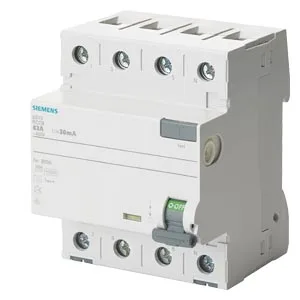
Type F means it handles residual currents with mixed frequencies — the kind you get from variable-speed drives, washing machine motors, and other single-phase inverter-fed loads — without nuisance tripping on high-frequency leakage. It's short-time delayed, so it coordinates with downstream devices and avoids tripping on transient surge currents up to 3 kA.
The 300 mA trip threshold is a deliberate choice: it's for equipment protection, not personnel shock protection (that's 30 mA or lower). You'd use this where you need leakage detection on a circuit with natural earth-leakage from filters or drives, but don't want a nuisance trip at 30 mA. The derating curve matters if your panel runs hot. At 45 °C it carries 77.57 A; at 50 °C, 74.59 A; at 60 °C, 64.47 A. If your enclosure hits 65 °C, you're down to 57.35 A — that's a 28% loss from the 80 A nameplate. Plan your load accordingly, especially if the RCCB sits near transformers or drives inside a sealed cabinet.
Mounting position is any orientation, so you can lay it sideways in a shallow enclosure if needed. The 70 mm depth matches standard distribution board cutouts. Supply can come from top or bottom — no forced busbar orientation. IP20 with conductors connected, so it's for enclosed panels only, not washdown areas.