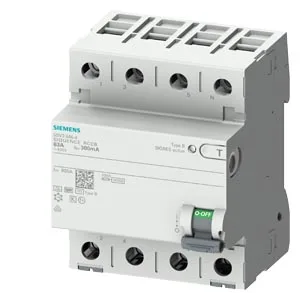
Type B means it detects AC, pulsating DC, and smooth DC residual currents — needed on drives, UPS systems, or any load with rectifiers that can produce DC fault current. The selective (S-type) design introduces a deliberate short delay so that downstream RCCBs trip first, keeping this unit as the backup in a coordinated panel.
Above that it derates: 72 A at 55 °C, 64 A at 60 °C, 56 A at 65 °C, and 48 A at 70 °C — so if the panel runs hot, size the load accordingly. The short-circuit current rating (SCCR) is 10 kA per IEC 61008-1, with a let-through current of 7 000 A and a permissible I²t of 60 000 A²·s. Overvoltage category III means it's rated for fixed-installation distribution boards, not just socket outlets. The residual current trip is fixed at 300 mA — not adjustable. That's a common value for selective (S-type) RCCBs because it reduces nuisance tripping on circuits with natural leakage. Surge current resistance is rated at 5 kA (8/20 µs waveform), and the device also meets the 0.8 kA rating per IEC 61008-1 for withstanding fault currents without degradation. Supply voltage range is 70–440 V AC, 50/60 Hz, and the test circuit minimum is 70 V.
Snap-on DIN rail (REG) mounting, any orientation. Depth is 70 mm, width 72 mm (4 MW), height 90 mm. IP20 with distribution board installed and conductors connected — so it's for enclosed panels, not open washdown areas. Operating ambient -25 to 45 °C; storage -40 to 75 °C.