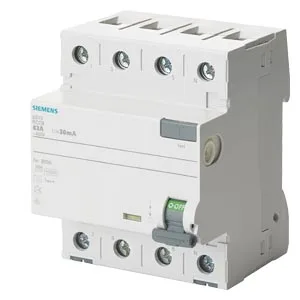
Type A detection means it picks up both sinusoidal AC residual currents and pulsed DC residual currents up to 6 mA — the kind you get from single-phase rectifiers in VFDs, switching power supplies, and LED drivers. That 300 mA sensitivity is a common choice for general distribution where you want earth-fault protection without nuisance tripping from normal leakage on long cable runs or filtered loads.
Snaps onto a DIN rail (REG profile) and takes 4 modular width units at 60 mm grid spacing. Dimensions are 72 mm wide × 90 mm high × 70 mm deep. Mounts in any orientation. Feed from top or bottom; the design is instantaneous (no intentional short-time delay), so it responds to a fault within one mains cycle. Silicon-free construction, which matters if this goes into a paint shop or coating line where silicone outgassing can cause adhesion failures. IP20 with conductors connected — fine inside a distribution board, not for wet or washdown locations.
If you're packing multiple devices in a small panel, that heat adds up; check your thermal budget. The 0.8 kA rated conditional short-circuit current per IEC 61008-1 is the maximum prospective fault current the RCCB can withstand when backed by a suitable overcurrent protective device (the series fuse must not exceed 63 A).