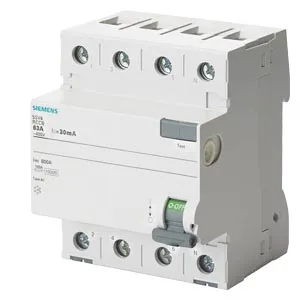
The Type AC designation means it detects sinusoidal AC residual currents only; if your load includes rectifiers, VFDs, or switched-mode supplies that generate pulsed or DC fault currents, you'll need a Type A or Type F RCCB instead. The short-time delayed characteristic provides selectivity with downstream RCCBs — it holds during transient earth faults (e.g., from motor starts or capacitor switching) so only the faulted sub-circuit trips, not the main board. Rated current holds at 63 A from 40 °C through 60 °C (–), then derates to 57.35 A at 65 °C and 48.8 A at 70 °C (–). That's a clean thermal curve — no derating needed in a standard 40 °C panel, but if the board sits near a heat source or in a hot environment, account for the drop above 60 °C.
Depth is 70 mm — that's the body depth; the terminals accept top or bottom feed, so plan your busbar routing accordingly. IP20 rating applies when installed in a distribution board with conductors connected — it's not a standalone outdoor device.