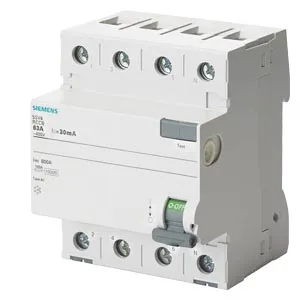
It's an instantaneous device (no intentional delay), designed for 230/400 V, 50 Hz networks.
At 65 °C it drops to 57.35 A, and at 70 °C to 48.8 A. If your enclosure runs hot, factor that in; otherwise the full 63 A is available across the normal operating range. The 100 mA trip sensitivity is for equipment protection or circuits with high leakage (e.g., long cable runs, industrial loads), not personnel shock protection — that's the 30 mA class. Type AC means it detects pure sinusoidal AC faults only; if your load has pulsed DC (VFDs, rectifiers, UPS), you need Type A or B instead. Overvoltage category III confirms it's rated for fixed-installation distribution boards, not just downstream equipment.
Depth is 70 mm — check your enclosure depth, especially if the busbar system or wiring channels reduce clearance. Silicon-free construction (no silicone potting or coatings) matters for paint shops or applications where silicone outgassing causes adhesion or contamination issues. Mechanical life is 10 000 switching cycles typical — fine for a protective device that operates infrequently, not for a switch used as a daily disconnect.