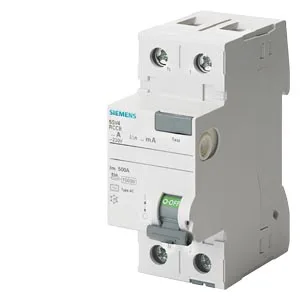
The 300 mA trip threshold is an instantaneous design (no intentional delay), so it clears ground faults fast. At 45 °C it's 77.87 A, at 50 °C it's 74.77 A, and it drops to 48.19 A at 70 °C. That derating curve matters if this RCCB sits in a hot enclosure near transformers or drives — the real-world ampacity is the temperature-corrected number, not the sticker.
The 5SV4617-0KL takes up 2 width units (36 mm) on the DIN rail, with a 70 mm installation depth — standard for a 2-pole RCCB in this class. Mounting position is any, so you can flip it upside down if the busbar layout demands it. Supply can come from top or bottom; the design is marked 'N left' per the SENTRON convention. Terminals accept solid or stranded copper from 0.75 mm² up to 35 mm² — that covers everything from a 2.5 mm² lighting circuit tail to a 35 mm² subfeed. The I²t withstand is 110,000 A²s, so it coordinates with most downstream MCBs without the RCCB being the weak link in the fault chain. The housing is finger and back-of-hand safe per the standard, so you're not getting a shock if you brush the terminals with the cover off.