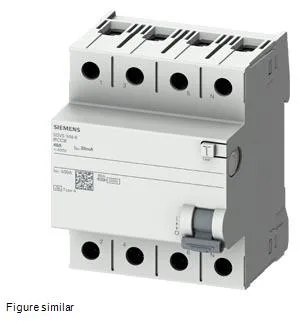
The Siemens 5SV5646-0 is a 4-pole residual current operated circuit breaker (RCCB) from the SENTRON family, rated 63 A at 230/400 V AC, 50 Hz, with a 300 mA trip threshold and Type AC sensitivity.
Depth is 70 mm, width 72 mm (4 MW), height 90 mm. Mounting position is any orientation — no derating needed for horizontal or inverted placement. Installation depth matches the 70 mm body depth; no extra clearance needed behind the rail. The silicon-free construction matters if this goes into a paint shop or potting line where silicone outgassing causes adhesion failures.
The 63 A rating is at 40 °C ambient; the thermal power dissipation per pole is 3.9 W in hot operating state — factor that into enclosure heat rise if you're packing 4+ units side by side. The 300 mA trip threshold is Type AC (sinusoidal AC residual currents only), not suitable for pulsed DC or smoothed DC fault currents — if your load includes VFDs, UPS, or rectifiers, you need Type A or B. The 6 kA SCCR is the conditional rating per IEC 61008-1 at 0.8 kA let-through; the maximum permissible series fuse is 80 A. The I²t let-through is 110 000 A²·s, and the peak let-through current is 7 100 A — these matter for selectivity coordination with upstream MCBs. Mechanical life is 2 000 operating cycles typical — adequate for a distribution board, not for frequent switching duty.