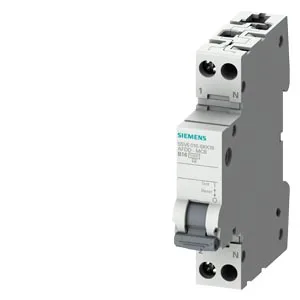
It protects final circuits against overload, short-circuit (B-curve, 6 kA per EN 60898-1 and IEC 60947-2), and series/parallel arcing faults that standard breakers cannot detect. The 1P+N design switches the line and switches the neutral, making it suitable for single-phase 230 V AC, 50 Hz circuits in residential and commercial distribution boards.
Rated at 6 A with a B-curve trip characteristic: the magnetic trip fires at 3–5× In (18–30 A), so it is a good match for resistive and general-purpose loads like lighting circuits, socket outlets, and small appliances — not for motor starting where a C or D curve would be needed to avoid nuisance trips on inrush. Breaking capacity of 6 kA per both EN 60898-1 and IEC 60947-2 means it can safely interrupt fault currents up to 6 kA at 230 V AC. For higher fault levels, step up to the 10 kA or 15 kA variants in the same family. The arc-fault detection function covers series arcs (minimum 2 A, maximum 6 A) and parallel arcs (minimum 50 A, maximum 500 A) — the range where smoldering faults in damaged cables or loose connections typically occur before they escalate to a hard short.
Snaps onto a DIN rail (EN 60715) in any mounting position, takes one modular width (18 mm), and requires 70 mm installation depth behind the panel — the 68.5 mm body depth plus clearance for conductors.