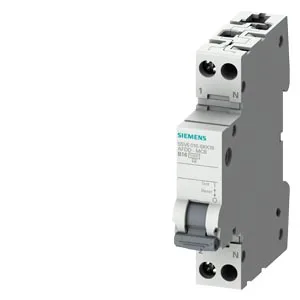
It's rated 13 A, C-curve, 230 V AC, with a 6 kA breaking capacity per both IEC 60947-2 and EN 60898-1. That 6 kA is the short-circuit capacity at the terminals; the real value here is the integrated arc-fault detection, which catches series arcs down to 2 A and parallel arcs up to 500 A.
If your panel has a higher available fault current, you'll need to coordinate upstream or step to a higher-rated device. The arc-fault detection side is what separates this from a plain MCB. It detects low-energy series arcs (as low as 2 A) that a standard breaker won't trip on — those are the ones that start fires behind drywall or in junction boxes. The parallel arc detection (50 A to 500 A) covers the higher-energy fault between line and neutral or ground. This unit does both in one 18 mm slot, saving rail space over separate AFCI and MCB devices. The 1P+N configuration switches the phase and monitors the neutral, but does not switch the neutral — it's a solid neutral path through the device. That's standard for single-pole AFCI/GFCI breakers in North American practice, though this is a DIN-rail format for European and IEC-style panels. The neutral conductor is not disconnected when the breaker trips, which matters for maintaining circuit integrity downstream.
Installation depth is 70 mm; the device body is 68.5 mm deep, so it sits flush with the rail edge. That covers unconditioned enclosures in most climates.