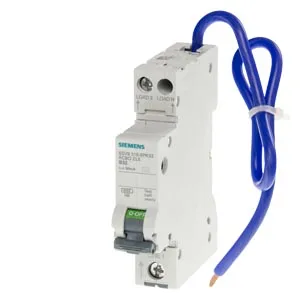
It protects a single-phase (1P+N) circuit against overload, short-circuit, and earth faults, with a 30 mA residual-current trip threshold and a B tripping characteristic for resistive or light inductive loads. Rated 16 A at 30 °C, it derates to 15.2 A at 40 °C and 13.76 A at 55 °C — the thermal curve matters if the distribution board runs warm. The Type A residual-current detection handles pulsating DC faults — common with electronics, rectifiers, and variable-speed drives — not just sinusoidal AC. That makes it a better fit than a basic Type AC for modern loads.
At 18 mm wide (1 MW), it takes minimal panel space. Depth is 77 mm, installation depth 70 mm — check the gland plate clearance if the enclosure is shallow. Supply connects from below per the design. Silicon-free construction matters for environments where silicone outgassing can contaminate contacts or optics — automotive paint shops or certain clean-room lines, for instance.