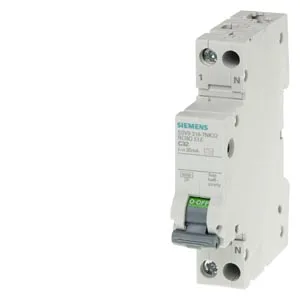
The Siemens SENTRON 5SV9316-7NK06 is an RCD-operated circuit breaker — an RCBO — combining overcurrent protection and residual current detection in a single 1 MW (18 mm) module. It's rated 6 A with a C tripping characteristic, 30 mA residual sensitivity, Type A (pulsating DC and AC fault currents), and a 6 kA breaking capacity per EN 60898 and IEC 60947-2. The 30 mA residual trip threshold covers personnel protection (hand-to-hand or hand-to-ground fault path) per IEC 60364.
Temperature derating — the number that actually governs your load
At 40 °C it derates to 5.64 A; at 45 °C to 5.46 A; at 50 °C to 5.22 A; at 55 °C to 5.04 A. If this RCBO lives in a crowded enclosure or near a heat source, size the upstream load against the derated figure, not the 30 °C headline. A 5.5 A continuous draw at 50 °C is fine; a full 6 A at that temperature will nuisance-trip on thermal overload.
Panel fit and installation constraints
Snaps onto DIN rail (35 mm EN 60715) in any mounting position. The 18 mm width (1 MW) means it occupies one modular slot — tight for a 1P+N RCBO with both overcurrent and RCD in one unit. Supply can enter from top or bottom; the design is instantaneous (no intentional time delay on the RCD element), so it's not suitable for selectivity with downstream Type G/S delayed RCDs — coordinate on time grading if used in a multi-level RCD scheme. IP20 rating applies only when installed in a distribution board with conductors connected — the terminals are finger-safe but the module itself is not sealed against dust ingress.
Halogen-free and silicon-free construction (no silicone outgassing issues in clean environments or near sensitive contacts). Insulation voltage rated 264 V; surge voltage resistance 4 000 V; surge current withstand 1 kA (8/20 μs waveform). The manufacturer provides EN/IEC declaration of conformity and CE marking; RoHS and REACH compliance documentation is standard with the SENTRON series.