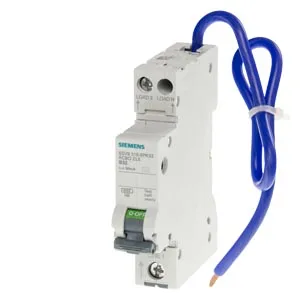
The Siemens SENTRON 5SV9316-7PK32 is a 2-pole RCD-operated circuit breaker — an RCBO — combining overcurrent protection and residual current detection in a single 18 mm module. Rated 32 A at 30 °C with a 30 mA trip threshold and Type A residual current sensitivity, it catches both sinusoidal AC and pulsating DC fault currents, which covers most modern electronic loads like VFDs, switched-mode supplies, and LED drivers. Breaking capacity is 6 kA per both EN 60898 and IEC 60947-2, so it's sized for standard domestic and light commercial distribution boards where the prospective fault current stays under that threshold. The C-curve (tripping characteristic C) means magnetic trip between 5 and 10 times In — typical for inductive loads like small motor circuits and fluorescent lighting banks where you need to ride through inrush without nuisance trips.
What the ratings mean for fit
At 18 mm wide (1 MW unit), it snaps onto standard DIN rail and occupies one slot — important when you're packing a multi-way distribution board and every module position is budgeted. Depth is 77 mm, installation depth 70 mm, so it clears most shallow enclosures, but verify the gland plate clearance if the board is tight. Temperature derating is published: 32 A at 30 °C drops to 30.4 A at 40 °C, 29.44 A at 45 °C, 28.8 A at 50 °C, and 27.84 A at 55 °C. If your panel ambient runs hot — say a sealed outdoor enclosure in summer — size the upstream protective device for the derated value, not the 30 °C headline. Rated insulation voltage is 264 V, overvoltage category III, pollution degree 2 — standard for fixed-installation distribution boards. Supply connects from below (position of power supply cord), which is the usual European convention; verify if your board busbar arrangement expects top feed. IP20 with the distribution board installed and conductors connected — that's touch-proof once enclosed, not rated for wet or dusty environments. The silicon-free marking matters if this board sits in a paint shop or coating line where silicone outgassing causes adhesion failures.
Panel integration notes
Mounting position any — no restriction on horizontal or vertical orientation, which simplifies layout in tight enclosures. Touch protection is built in, so no additional finger-safe shrouds needed for the line-side terminals. The instantaneous design means no intentional time delay on the residual current element — it trips within the standard response time for Type A RCDs. If you need selectivity with downstream RCDs, you'll want a time-delayed (S-type) device upstream instead.
