What the F1 curve and 0.5 A rating mean for your panel
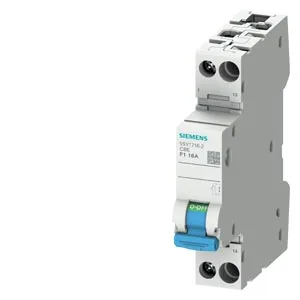
The Siemens 5SY1705-2 is a 1-pole device protection switch from the SENTRON family, carrying an F1 tripping characteristic and a 0.5 A rated current. The F1 curve is a fast-acting characteristic — it trips within 0.1 s at about 2.5× to 5× rated current — designed for semiconductor protection or sensitive electronic loads where standard B/C curves would allow too much energy through. At 0.5 A, this breaker protects a single branch drawing up to 115 VA at 230 V AC or 30 W at 60 V DC. Rated for both AC and DC operation — 230 V AC (single-phase, up to 250 V max) and 60 V DC (up to 72 V max) — with a breaking capacity of 3 kA AC per IEC 60934. It also carries UL1077 recognition as a supplementary protector, meaning it's accepted for use in UL 508A industrial control panels downstream of a branch-circuit protective device. The built-in auxiliary switch (NO contact) signals the breaker's status — open or closed — to a PLC or indicator lamp without needing a separate auxiliary block. That saves a DIN-rail slot and wiring time on panels where status feedback is required.
Horizontal or vertical orientation is permitted; the breaker operates correctly in both positions. Sealable with a lead or tag to prevent unauthorized switching. Supply cord can enter from any direction — top, bottom, or side — giving flexibility in tight enclosures. No combined neutral terminal and no neutral conductor switching; this is a single-pole line breaker only.
Rated for ambient temperatures from -40 °C to +70 °C, with derating required above 30 °C at 85% relative humidity and above 60 °C at 20% relative humidity. The F1 characteristic's thermal-magnetic trip is calibrated at 30 °C; expect the magnetic trip threshold to shift slightly at temperature extremes — account for this in coordination studies. Overvoltage category III (distribution level) and pollution degree 2 (normal factory/office environment). Vibration resistance tested per IEC 60068-2-6, so it holds up on machine-mounted panels.