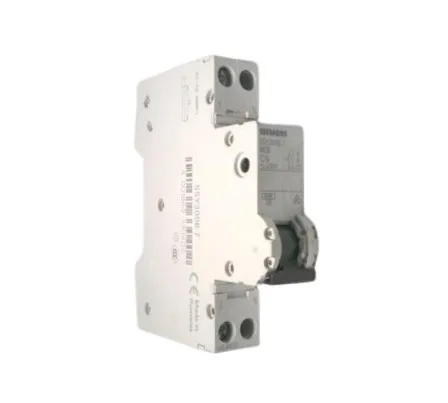
The Siemens 5SY3013-7KL is a 1P+N miniature circuit breaker from the SENTRON family, rated 13 A with a C tripping characteristic and a 4.5 kA breaking capacity at 230 V AC. It occupies a single 18 mm width unit on standard DIN rail, so it fits a panel slot the same size as any single-pole breaker — but it switches both the line and the neutral. The neutral pole is switched internally, which means you don't need a separate neutral disconnect for the circuit; the breaker opens both conductors on a fault.
The C-curve (tripping characteristic class C) means the magnetic trip activates at 5 to 10 times the rated current — so for a 13 A breaker, the instantaneous trip point is between 65 A and 130 A. That's the standard choice for motor circuits, transformers, and lighting banks with moderate inrush; it avoids nuisance trips on startup while still clearing hard faults. The 4.5 kA breaking capacity at 230 V AC (per EN 60898) tells you the breaker can safely interrupt a fault current up to 4.5 kA without welding its contacts or failing catastrophically. The 1P+N configuration with neutral switching (product function neutral conductor switching = Yes) means the breaker disconnects both poles on a fault. That's useful for single-phase final subcircuits where you want full isolation — the load sees both line and neutral opened, not just the line. The neutral pole is not overcurrent-protected; it's a switched neutral that tracks the line pole mechanically. Terminals accept solid or stranded conductors from 0.75 mm² up to 16 mm², with a tightening torque of 2 to 2.5 N·m (17.7 to 22.1 lbf·in). That range covers everything from 1.5 mm² lighting circuits up to 6 mm² or 10 mm² feeder tails. The screw terminals are not combined top/bottom (combined terminal top = No, combined terminal bottom = No), so each conductor gets its own clamping point — no shared tunnel that can loosen under vibration. That 6 mm difference is the front projection of the toggle and the sealable cover (sealable = Yes). If you're fitting a gland plate or enclosure door, account for the toggle throw — the breaker needs clearance to operate fully without binding. The mounting position can be any orientation (mounting position = any), which helps in tight enclosures where you might need to lay the breaker sideways.
Energy limiting class 3 means the breaker limits the let-through energy (I²t) to a low level during a short circuit, which helps protect downstream equipment. Vibration resistance per IEC 60068-2-6 is confirmed, so it's suitable for installation on machinery or in mobile equipment that sees regular vibration.