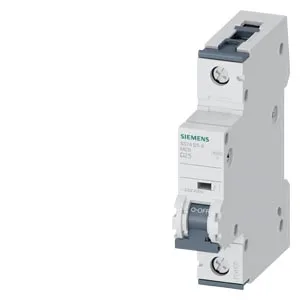
It's rated to clear faults at 10 kA per EN 60898-1 and 20 kA per IEC 60947-2 at 400 V AC, with a DC breaking capacity of 15 kA at 60 V per IEC 60947-2.
Breaking capacity and standards
This MCB carries dual-standard ratings: 10 kA under IEC/EN 60898-1 and 20 kA under IEC 60947-2, both at 400 V AC. At DC, it's rated 15 kA at 60 V (IEC 60947-2). For UL 1077 / CSA C22.2 No. 235 applications, the interrupting capacity is 5 kA. The operating voltage range covers 400 V AC single-phase and 440 V AC multi-phase, with a DC max of 72 V.
D-curve and deployment context
The D characteristic (tripping between 10x and 20x In) suits motor starting, welding circuits, and transformer primaries where the inrush can hit 12–15x full-load current for a few cycles. A B- or C-curve breaker would nuisance-trip on that same surge.
Operating temperature range is -40 °C to 75 °C, with humidity derating: max 95% up to 55 °C, then dropping to 35% at 75 °C. It's sealable (provision for a lead seal or lock) and carries IP20 protection with connected conductors. Vibration resistance per IEC 60068-2-6 covers ±1 mm at 5–25 Hz and 50 m/s² at 25–150 Hz — enough for pump skids and conveyor drives that rattle the panel.