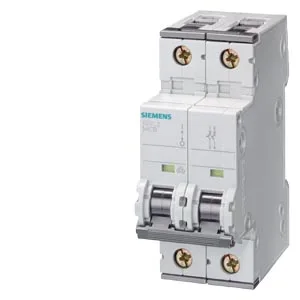
The Siemens 5SY4213-7 is a 2-pole miniature circuit breaker from the SENTRON family, built to IEC / EN 60898-1 and IEC / EN 60947-2 / UL1077 standards. It snaps onto a DIN rail — any mounting position works — and takes up two modular width units (36 mm wide, 76 mm deep, 90 mm tall). Rated 400 V AC (440 V max in multi- or single-phase operation) and 60 V DC (72 V max), with a C tripping curve that handles moderate inrush from motor starters and lighting ballasts. The 10 kA breaking capacity per EN 60898 covers most commercial panel faults; the 20 kA rating per IEC 60947-2 gives headroom for industrial distribution where fault currents run higher. DC-side breaking is 15 kA per IEC 60947-2, and UL 1077 listing is 5 kA for North American panels.
Compliance documentation covers IEC/EN 60898-1, IEC/EN 60947-2, and UL1077. The breaker is halogen-free and silicon-free, rated for pollution degree 3 and overvoltage category III, with an IP20 enclosure (IP20 with conductors connected).
The C-curve (tripping characteristic C) means it holds through 5–10× rated current for short-duration inrush — typical for motor starters, small transformers, and capacitor banks. If your load is purely resistive (heaters, incandescent lighting), a B-curve would trip faster; if it's heavy inductive (large motors, welding gear), a D-curve might be needed. This one splits the difference for general industrial and commercial panels. Temperature range is -40 °C to 75 °C, with humidity derating above 55 °C (max 95% RH at 55 °C, dropping to 35% at 75 °C).