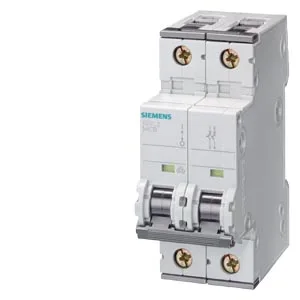
This means it's built for high inrush loads — motor circuits, transformers, welding equipment — where the D curve allows a short magnetic trip delay to pass starting currents without nuisance tripping. Rated 400 V AC with a 10 kA breaking capacity per EN 60898, and 5 kA per UL 1077 / CSA C22.2 No.235.
D-curve selectivity and application
The D tripping characteristic (10–20 × In magnetic release) is the key differentiator from a B or C curve MCB. For a 20 A breaker, the magnetic trip threshold sits between 200 A and 400 A. That headroom lets motor starters and soft-starts ride through their inrush without the breaker opening — something a B-curve (3–5 × In) cannot guarantee on a refrigerated compressor or a hydraulic pump start. Rated DC side up to 72 V maximum — relevant for control-circuit protection in mixed AC/DC panels where the same breaker type is used across the rail.
Deployment and environmental
Humidity derating applied: max 95% at 55 °C, tapering to 35% at 75 °C. Halogen-free and silicon-free construction — important for clean-room or sealed-panel environments where outgassing contaminates optics or contacts. Touch protection integrated. Sealable terminals available (yes) for tamper-proof installations in utility or metering applications.