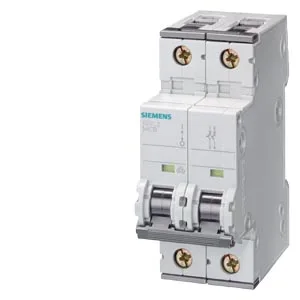
Its C-curve tripping characteristic (rated per EN 60898) means it handles inrush currents 5–10 times the rated current before tripping — the standard choice for motor-starter and transformer-fed loads where a brief surge is expected. Rated 10 kA breaking capacity at 400 VAC per EN 60898, with a 5 kA interrupting rating under UL 1077 and CSA C22.2 No.235 — so it safely clears a fault up to those levels without welding its contacts or cascading the failure upstream.
Supplementary devices (shunt trips, auxiliary contacts, alarm switches) are installable on this breaker, so a panel can be built or retrofitted with remote-tripping or status-monitoring functions without swapping the base unit.
Where it fits — dimensions and environment
76 mm deep, 36 mm wide, 90 mm tall. Installation depth 70 mm.
Engineering judgement on the ratings
The 10 kA SCCR at 400 VAC is the IEC rating that governs selectivity in a European-style distribution board. Under UL 1077 the same breaker is listed at 5 kA — a lower figure that reflects the different test protocol, not a defect. If your panel is built to UL 508A, coordinate the 5 kA figure with the upstream fault current. If the load is purely resistive (heaters, lighting) a B-curve would give better protection; if it is a large motor start, a D-curve might be needed. This is the middle ground.