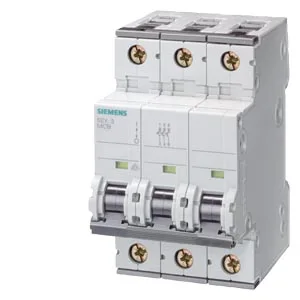
The Siemens 5SY4302-7CC11 is a 3-pole miniature circuit breaker from the SENTRON family, rated 2 A with a C tripping characteristic and a 10 kA breaking capacity at 400 V AC per EN 60898. It is designed for railway applications and general mechanical engineering/industry use, with a quick assembly mounting system that snaps onto DIN rail in any position. At 54 mm wide (3 width units) and 76 mm deep, it fits standard 18 mm/module DIN-rail enclosures; the 70 mm installation depth leaves room for gland plates and cable bends behind the panel door.
Rated 2 A at 400 V AC, this breaker protects a single-phase or three-phase circuit drawing up to 2 A per pole — sized for small control transformers, signal-conditioning power supplies, or auxiliary relay buses in a larger panel. The 10 kA breaking capacity at 400 V AC (EN 60898) means it can safely interrupt a fault current up to 10,000 A without welding contacts or rupturing the case. Overvoltage category III covers fixed-installation distribution boards, not just socket outlets. Terminals accept solid or stranded copper from 0.75 mm² up to 35 mm², with a tightening torque range of 2.5 to 3.5 N·m. The combined terminal design (top and bottom) allows daisy-chaining or loop-through wiring without separate feed-through lugs. Rated for ambient temperatures from -40 °C to +70 °C and storage from -40 °C to +75 °C, with humidity derating: max 95% RH at 55 °C, 55% at 70 °C, 35% at 75 °C. IP20 protection (with connected conductors) means it's suitable for enclosed panels, not outdoor or washdown zones.
The closest functional peer is the 5SY6602-8, also a 3-pole C-curve MCB from the same SENTRON family. The key difference: the 5SY6602-8 is rated 63 A, not 2 A, and carries a 25 kA breaking capacity at 400 V AC versus this part's 10 kA. The 5SY4302-7CC11 is the correct choice when your BOM calls for a 2 A branch protection; the 63 A variant would not trip on a 2 A overload and offers no advantage in a low-current circuit.