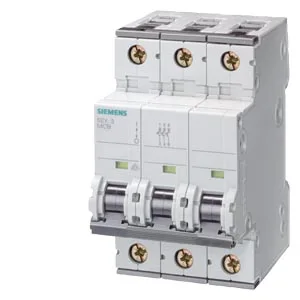
The Siemens SENTRON 5SY4306-6-ZW09 is a 3-pole miniature circuit breaker (MCB) with B-curve tripping characteristic, rated for 10 kA interrupting capacity per EN 60898-1 and 35 kA per IEC 60947-2. The 35 kA rating under IEC 60947-2 gives you the SCCR headroom for industrial panel coordination; the 10 kA per EN 60898-1 is the residential/commercial branch-circuit number. For UL 1077 applications, it's rated 5 kA. It's designed for 400 V AC (440 V max multi- or single-phase) and 60 V DC (72 V max). The 3-pole design switches all three phases simultaneously — no neutral pole, so it's for three-phase loads or three-phase distribution.
Deployment and panel integration
Snaps onto DIN rail via the quick assembly system — 3 modular width units (54 mm wide), 90 mm tall, 76 mm deep (70 mm installation depth). Mounts in any position, which simplifies layout in crowded enclosures. Sealable, which matters for applications requiring tamper-proof isolation per site lockout procedures.
Halogen-free and silicon-free construction, which matters for outgassing-sensitive environments like clean rooms or sealed enclosures where corrosive byproducts from a fault could damage nearby electronics. Temperature range covers -40 °C to 75 °C, with humidity derating above 55 °C (95% RH to 55 °C, 55% RH to 70 °C, 35% RH to 75 °C). Complies with IEC/EN 60898-1, IEC/EN 60947-2, and UL 1077 / CSA C22.2 No.235. Energy limitation class 3, meaning it limits let-through energy on faults — aids downstream coordination.