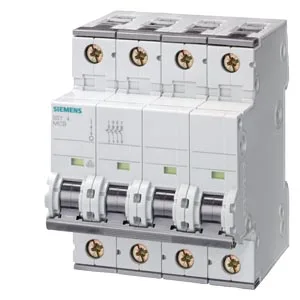
For a 4-pole breaker in a panel, that's the go-to for general distribution and lighting circuits where you need selectivity downstream.
Breaking capacity and compliance — what the dual rating means for your panel
Two breaking capacity numbers are listed because two standards apply. Under DIN EN 60898-1 (the residential/commercial MCB standard) it's rated 10 kA. Under IEC 60947-2 (the industrial standard for circuit breakers) it's rated 20 kA, and at DC per IEC 60947-2 it's 15 kA. The DC rating of 15 kA at 60 V covers control-circuit and battery-backed loads. Compared to a standard 6 kA domestic MCB, this part gives you real fault-current headroom. The 20 kA IEC rating means it coordinates with upstream fuses or a larger moulded-case breaker without requiring a current-limiting device ahead of it — saves a fuse holder and a wiring step in the panel.
Integration — DIN rail, IP20, and environmental limits
At 72 mm wide (4 modular units) and 76 mm deep, it fits a standard distribution board or industrial enclosure without protruding past the gland plate. Ambient temperature range is -40 °C to +75 °C, with humidity derating above 55 °C: max 95% RH at 55 °C, dropping to 35% at 75 °C. No neutral conductor switching — this is a 4-pole breaker that switches all four phases but does not break the neutral; the neutral bar stays continuous through the device.