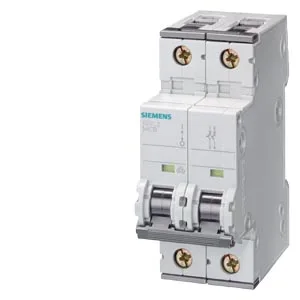
Rated 10 kA under IEC/EN 60898-1 and 35 kA under IEC 60947-2, it covers most residential and light commercial fault levels; the 35 kA figure applies when the breaker is used as a distribution-level device per the industrial standard. The C-curve (5× to 10× In magnetic trip) handles inrush from motor starters and lighting ballasts without nuisance trips, while still clearing short circuits fast.
The 5SY4501-7's dual breaking capacity tells you which standard governs your installation. For a residential or commercial board designed to EN 60898-1, you get 10 kA at 230 V AC — enough for most utility-transformer-fed services. If the same breaker goes into an industrial panel where IEC 60947-2 applies (higher prospective fault current), it's rated 35 kA at 230 V AC. That's the same hardware, just certified to both standards. Under UL 1077 and CSA C22.2 No. 235, the rating drops to 5 kA — still sufficient for supplementary protection in North American control panels, but not for branch-circuit primary protection there. The 1P+N design with switched neutral means the neutral pole opens and closes with the phase. That's required in some regional wiring codes (e.g., UK, Australia) for single-phase final circuits, and it simplifies isolation — one breaker disconnects both conductors. The 2-module width (36 mm) on DIN rail is standard; it occupies the same footprint as a 2-pole breaker but with the neutral pole not thermally protected, just switched.
Deployment context
This breaker lands in a DIN-rail enclosure — typically a consumer unit, sub-distribution board, or industrial control panel. The wide ambient range (-40 °C to 75 °C) covers unheated plant rooms and outdoor kiosks, but the derating curve matters: at 55 °C the breaker carries 95% of rated current, dropping to 55% at 70 °C and 35% at 75 °C. If the panel runs hot, you need to upsize the breaker or reduce the load.
Compliance documentation
The breaker carries IEC/EN 60898-1 and IEC/EN 60947-2 certification, plus UL 1077 and CSA C22.2 No. 235 for North American supplementary protection. The sealable design allows panel builders to lock the toggle position after commissioning.