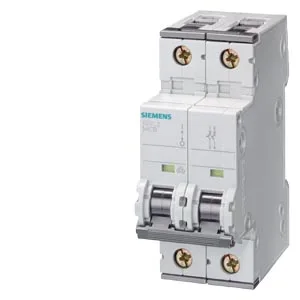
The D curve means it's designed to handle the inrush from motor loads or transformers without nuisance tripping, making it a fit for mechanical engineering and industrial equipment.
Under UL 1077 and CSA C22.2 No. 235, it's rated 5 kA, so if the panel needs a UL-listed branch circuit protector, that's the number to coordinate with the upstream breaker. The D characteristic trips between 10 and 20 times rated current (40–80 A magnetic trip), which is why it's chosen for motor starters and drives where the starting surge would pop a B or C curve.
What else matters for the install
The housing is IP20 with conductors connected, so it's not for washdown zones, but it's fine inside a sealed enclosure. It switches the neutral (1P+N design), which is important for single-phase circuits where you want to isolate both poles on a fault. The supply can come from either end — top or bottom — and you can add auxiliary contacts or shunt trips later since it accepts supplementary devices. Vibration resistance is tested to IEC 60068-2-6: ±1 mm at 5–25 Hz and 5 g at 25–150 Hz, so it'll hold up on a machine base or a conveyor panel.