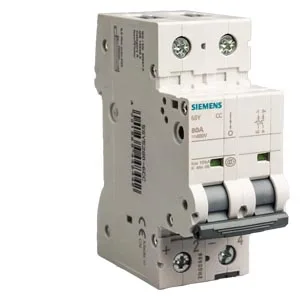
What it is and what it does
The Siemens 5SY4510-7CC is a SENTRON miniature circuit breaker (MCB) — a 2-pole unit wired as 1P+N, meaning it switches the line conductor and the neutral together. Rated 10 A at 35 °C with a C-curve trip characteristic, it's the go-to for general-purpose branch-circuit protection in distribution boards and control panels where moderate inrush (motors, transformers, capacitor banks) is expected. The 10 kA breaking capacity per EN 60898 tells you it can safely clear a fault up to that level without welding contacts or cascading upstream — standard for most commercial and light industrial sub-distribution.
What the ratings mean for fit
The C-curve means magnetic trip between 5× and 10× rated current — about 50 A to 100 A for this 10 A unit. That's wide enough to pass motor-start and capacitor-charging surges without nuisance trips, but tight enough to catch a hard short. If your load is purely resistive (heaters, lighting), a B-curve sibling would trip faster; if it's heavy inductive (large motors, welders), a D-curve might be needed. The 10 kA SCCR at 400 V AC (per EN 60898) is the standard for most final sub-circuits in Europe and Asia; if your available fault current is higher, you'd need a current-limiting upstream device or a higher-rated breaker. Temperature derating is baked in: at 40 °C ambient the breaker is good for 9.19 A, at 50 °C it's 8.29 A, and at 55 °C it drops to 7.81 A. If your panel runs hot — say, a sealed enclosure near a furnace line — size the load accordingly or step up one frame. The 2 MW (36 mm wide) footprint is standard for Siemens SENTRON 5SY series; it snaps onto DIN rail and occupies two 18 mm modular spaces.
Where it goes and how it mounts
Snaps onto standard 35 mm DIN rail via the quick-assembly system — no tools needed for installation or removal. Mounting position is any orientation, which helps in tight enclosures where vertical or horizontal rail layouts are mixed. The combined terminals at top and bottom accept both busbar and cable, and the neutral conductor is switched internally (1P+N design), so you don't need a separate neutral bar for the switched leg. Pollution degree 3 and overvoltage category III mean it's rated for industrial environments with conductive dust or condensation — typical for factory-floor distribution panels, not just clean control cabinets.