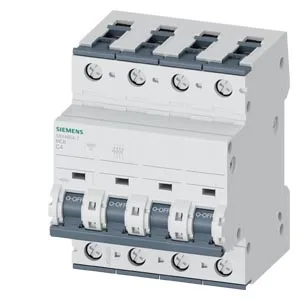
Rated breaking capacity is 10 kA per EN 60898 and 35 kA per IEC 60947-2, with a DC rating of 15 kA per IEC 60947-2. That 35 kA figure under the industrial standard tells you it can handle high fault currents common in panel-fed circuits — not just a residential box. The C-curve (5–10x In) is the standard choice for motor starters, small transformers, and general industrial loads where you need a little inrush headroom without moving to a D-curve.
At 4 A and 35 °C ambient it's rated a full 4 A; derate as the panel warms — 3.81 A at 40 °C, 3.61 A at 50 °C, 3.39 A at 60 °C. If your enclosure runs hot (say 55 °C), you're at 3.5 A — that's a 12.5% reduction. Factor that into your load calculation so the breaker doesn't nuisance-trip on a warm afternoon. Sealable design and touch protection are built in. Temperature range is wide: -40 °C to 75 °C operating. That covers cold storage, unheated warehouses, and hot machine cabinets. The humidity limits are also spelled out — 95% up to 55 °C, then derated. Good for condensation-prone environments as long as the panel is sealed.