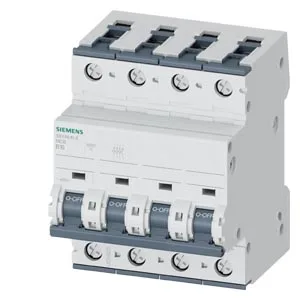
Siemens 5SY4616-6 — 4-pole B-curve MCB for panel builders
That matters when you need isolation on all conductors for maintenance or if your local code requires neutral disconnection on the final subcircuit. Tripping characteristic is B-curve (3–5× In instantaneous trip), so it's sized for resistive and general-purpose loads — lighting, small heaters, control transformers — where inrush isn't high enough to nuisance-trip a C-curve. On a food-and-bev line I'd use this for the panel lighting and convenience outlets, not motor circuits. At 400 V AC that's enough headroom for most industrial panel sub-distribution. If your upstream transformer is large enough to push fault current past 20 kA at the board, you'll need a current-limiting upstream device — but for a typical 630 kVA transformer feeding a MCC, this holds. It also carries a 15 kA DC rating per IEC 60947-2 at 60 V DC (max 72 V DC), which covers DC auxiliary circuits or battery-backed control busses — useful if you're feeding a 48 V DC control loop from the same panel.
The 90 mm height fits under any standard 120 mm tall enclosure backplate. Not for wet environments, but fine inside a Type 1 or Type 12 enclosure. Fastening method is quick-assembly system (the standard SENTRON clip), and the unit is sealable for metering or lockout-tagout compliance.
Environmental range and compliance
Ambient temperature range is -40 °C to +75 °C, with humidity derating above 55 °C (95% RH at 55 °C, down to 35% RH at 75 °C). That covers unheated outdoor enclosures in cold climates and hot panel interiors near drives or transformers.
Certified to IEC / EN 60898-1 (the MCB standard for household and similar installations) and IEC / EN 60947-2 (the industrial circuit-breaker standard). Also carries UL 1077 and CSA C22.2 No. 235 recognition for supplementary protection in North American panels — 5 kA at AC per those standards. Overvoltage category III (fixed installation, not plug-connected equipment). Energy limitation class 3 — the highest class, meaning it limits let-through energy effectively during a fault, reducing stress on downstream components.