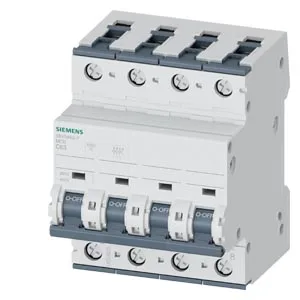
What This MCB Does in Your Panel
The Siemens SENTRON 5SY5463-7 is a 4-pole C-curve miniature circuit breaker rated for universal current — it handles both AC and DC circuits without derating the trip curve. The C-curve (tripping characteristic class C) means it holds through inrush up to 5–10× rated current, then clears fast on hard faults. That makes it the right choice for motor starter feeders, control transformers, and lighting panels where the load draws a moderate magnetizing surge. Breaking capacity sits at 10 kA per IEC/EN 60898-2 and UL1077 — enough for most commercial and light industrial distribution boards fed from a 100 kVA transformer. On DC circuits it delivers 10 kA per EN 60898-2 and 15 kA per IEC 60947-2, so it also covers DC auxiliary buses and battery-backed control supplies. Rated operating voltage is 400 V AC (440 V multi-phase or single-phase) and 880 V DC, with a maximum DC operating voltage of 1 000 V. The 50/60 Hz frequency range covers both 50 Hz and 60 Hz grids without a separate variant.
Mounting and Integration
Snaps onto DIN rail via the quick-assembly system — no tools needed for installation or removal. Occupies 4 modular width units (72 mm wide). Mounting position is any orientation, which simplifies layout in tight enclosures. Depth is 76 mm (installation depth 70 mm). The IP20 rating applies with connected conductors — the terminals are finger-safe only when wired. Combined top and bottom terminals allow daisy-chaining busbars without extra jumpers. Sealable design lets you lock the toggle in the OFF position for lockout/tagout compliance. Halogen-free and silicon-free construction matters for clean-room or high-reliability environments where outgassing contaminates contacts or optics.
Environmental and Compliance
Operates across -40 °C to 75 °C ambient, with humidity limits of 95% up to 55 °C, derating to 35% at 75 °C. Vibration resistance per IEC 60068-2-6: ±1 mm at 5–25 Hz, 50 m/s² at 25–150 Hz — survives shipping and fan vibration in industrial cabinets. Energy limitation class 3 means it limits let-through energy on short circuits, reducing arc-flash risk downstream and protecting sensitive loads.
