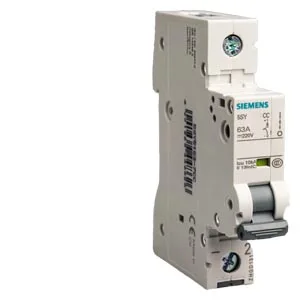
Siemens 5SY6140-8CC — 40 A D-Curve MCB for Motor and Transformer Circuits
Breaking capacity is 6 kA per EN 60898 and 5 kA per UL 1077 / CSA C22.2 No.235, so it handles fault currents up to those levels without welding contacts or cascading upstream. That 6 kA IEC rating covers most industrial panelboards on a standard 400 V supply; the UL/CSA listing gives you the same part for North American job sites where the code asks for UL 1077 recognition. Sealable, halogen-free, silicon-free construction — important if this lives in a food plant or a clean room where outgassing matters.
A D-curve MCB trips magnetically between 10× and 20× rated current. For this 40 A breaker, that magnetic trip kicks in somewhere above 400 A and below 800 A. That's the right window for motor circuits where the starting current hits 6–8× FLA for a few seconds, or for transformers that pull a magnetizing inrush. A C-curve (5–10×) would nuisance-trip on the same load; a B-curve (3–5×) would trip every time. The thermal element handles the sustained overload — it follows the standard inverse-time curve. So a 45 A overload on a 40 A breaker clears in minutes, not instantly. That's by design: lets a stalled motor heat up the bimetal and trip before the winding cooks, but doesn't react to the normal starting transient.
Width is 18 mm — that's one modular unit (1 MW) on a standard DIN rail. Snaps onto the rail via the quick-assembly system, no tools needed. Mounting position any orientation, so it fits vertical or horizontal busbars. This lives inside an enclosure, not out in the weather. Ambient temperature range -25 to +55 °C operating, with a wider -40 to +75 °C storage range. Humidity derating above 55 °C: max 95% RH up to 55 °C, then 55% at 70 °C, 35% at 75 °C.