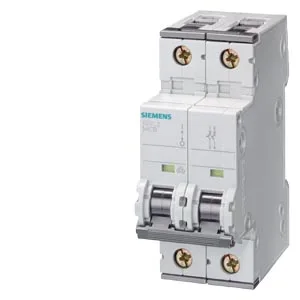
Its D-curve tripping characteristic is sized for loads with high inrush — think motor starters, small transformers, or solenoid banks — where a B- or C-curve would nuisance-trip on startup. Rated 3 A at 400 V AC, it breaks 6 kA per EN 60898 and 5 kA per UL 1077 / CSA C22.2 No. 235, so it clears a fault cleanly before an upstream device has to act. The 2-pole form switches both line conductors, but note it does not switch the neutral — that's a separate terminal bar or an additional pole if your circuit needs it.
A C-curve (5-10x) would trip sooner; a D-curve gives you that extra headroom. For a 3 A rating, that's a deliberate choice: you're protecting a circuit that pulls 3 A steady but sees a short spike on start. If your available fault current is higher, you'll need a current-limiting upstream breaker. The UL 1077 / CSA 5 kA rating covers North American installations; the breaker carries both marks, so it's accepted on both sides of the Atlantic.
Depth is 76 mm, height 90 mm. Both top and bottom terminals are combined, accepting a range of conductor sizes. The breaker is sealable for applications where you need to lock the handle position after commissioning.