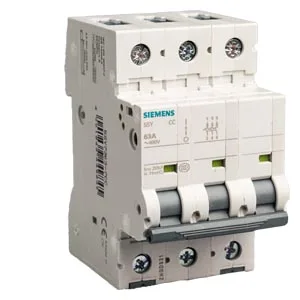
What this MCB is and what the key ratings mean for fit
The Siemens 5SY6306-8CC is a SENTRON miniature circuit breaker (MCB) with a D tripping characteristic, rated 6 A at 440 V AC on a 50/60 Hz supply. The D-curve means it tolerates inrush currents 10–20 times the rated current before tripping magnetically — the right choice for motor, transformer, or welding-equipment branch circuits where the start-up surge would nuisance-trip a B- or C-curve breaker. Its breaking capacity is 6 kA per EN 60898, which certifies it for interrupting short-circuit faults up to 6 kA at the rated voltage in a residential or light-industrial distribution board. The 3-pole design (3P) switches all three phases simultaneously, with no neutral pole switching. Thermal derating is documented: the 6 A rating holds at 35 °C ambient, drops to 5.51 A at 40 °C, 5.25 A at 45 °C, 4.97 A at 50 °C, and 4.69 A at 55 °C. If the panel ambient runs above 35 °C, the load current must be reduced accordingly — a common oversight when populating a dense DIN-rail enclosure.
Mounting and panel integration
The 5SY6306-8CC snaps onto a standard DIN rail via its quick-assembly fastening system and occupies 3 modular width units (54 mm). It can be mounted in any position, with an installation depth of 70 mm and an overall depth of 76 mm. The IP20 rating (with connected conductors) is typical for enclosed distribution boards — not for wet or washdown environments. Combined top and bottom terminals accept wiring without requiring separate neutral-link accessories for the load side. The housing is halogen-free and silicon-free, which matters for installations with strict fire-load or contamination specifications (e.g., rail, marine, or clean-room adjacent panels).
Environmental and compliance data
Rated for a surrounding-air temperature range of -40 °C to +75 °C, with humidity limits of 95% at 55 °C, 55% at 70 °C, and 35% at 75 °C. Pollution degree 3 and overvoltage category III per IEC 60664 — suitable for fixed installations where conductive pollution or transient overvoltages from the mains supply are expected.