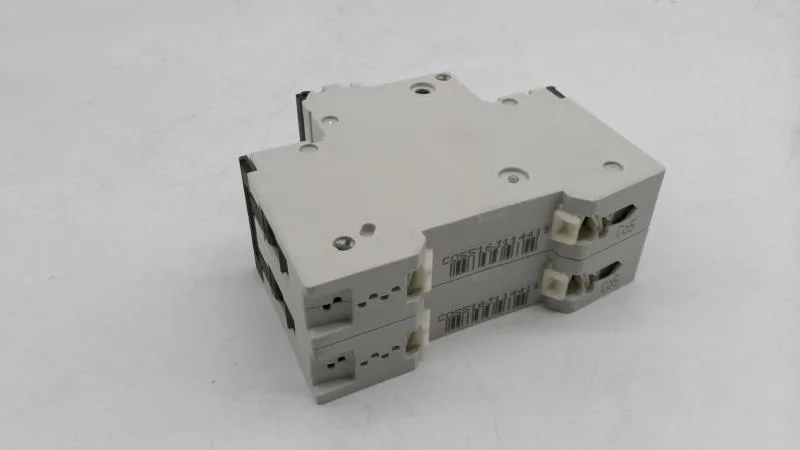
It's a 2-pole unit configured as 1P+N — meaning it switches the live conductor and provides neutral disconnection, which matters when you need full isolation on a single-phase circuit. At DC it's rated 15 kA per IEC 60947-2 up to 72 V, and under UL 1077 / CSA C22.2 No. 235 it carries 5 kA at AC. That UL/CSA rating means it's accepted in North American control panels as a supplementary protector, not a branch-circuit device. Rated voltage is 230 V AC single-phase (250 V for single-phase operation), with a maximum DC voltage of 72 V. The part is halogen-free and silicon-free, which is a spec that comes up when panels go into clean-room or semiconductor-adjacent environments where outgassing is restricted.
Width is 36 mm (2 width units at 18 mm each), depth 76 mm, height 90 mm. Installation depth is 70 mm — that's the space needed behind the panel door, not counting the busbar or wiring.
The 5SY6 design series is a mature line with broad acceptance across European and North American panel shops. The D-curve and 0.5 A rating are less common than the B or C variants at higher currents, so if you're filling a BOM line that calls for this exact code, the 1P+N configuration with neutral switching is the differentiator — a standard 2-pole MCB without neutral switching won't drop in functionally.
Rated per EN 60898 and IEC 60947-2, with supplementary UL 1077 and CSA C22.2 No. 235 recognition. The part is halogen-free and silicon-free, and the product designation follows DIN EN 61346-2 and DIN EN 81346-2 functional identification (letter F). These standards cover the declaration pack a quality-documentation controller would need for panel traceability.