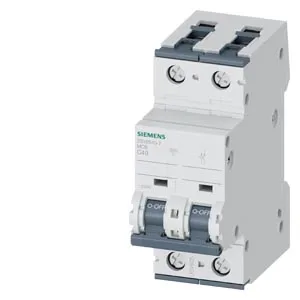
Breaking capacity sits at 6 kA per EN 60898 and 10 kA per IEC 60947-2; that 10 kA figure is the one that matters for industrial panel coordination — it tells you the breaker can safely interrupt a fault up to 10 kA at 230 V AC without welding its contacts or cascading upstream. At DC it's rated 15 kA at 60 V (max 72 V), so it also works in 48 V or 60 V battery-backed control circuits. IP20 with conductors connected, so it's a panel-internal part; no washdown rating. Temperature range is -40 °C to 75 °C, with derating above 55 °C per the humidity curve (max 95% RH at 55 °C, dropping to 35% at 75 °C).
Designed to IEC / EN 60898-1 (household-type MCB) and IEC / EN 60947-2 (industrial circuit-breaker standard), plus UL 1077 and CSA C22.2 No. 235 for North American supplementary protection. The UL 1077 rating is 5 kA — lower than the IEC figures, so if the panel is destined for a UL-listed machine, that 5 kA is the enforceable limit. Halogen-free and silicon-free construction, sealable (padlockable handle), and vibration tested per IEC 60068-2-6 (1 mm at 5–25 Hz, 50 m/s² at 25–150 Hz).