What it is and what the ratings mean
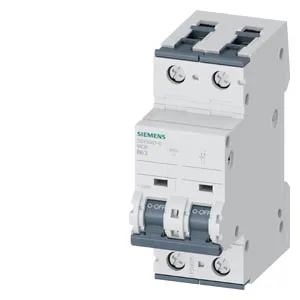
The Siemens 5SY6563-6 is a 2-pole miniature circuit breaker from the SENTRON family, wired as 1P+N — it switches the line conductor and the neutral together, so the neutral is never left live when the breaker is off. That matters for any circuit where an isolated neutral is a safety or code requirement, not just a convenience. Tripping characteristic B means the magnetic trip fires at 3 to 5 times rated current — the standard choice for resistive and general-purpose loads where inrush is modest. It is the curve you reach for when protecting lighting, control transformers, or distribution subfeeds that do not have motor-starting surges. Breaking capacity is dual-rated: 6 kA under EN 60898-1 (the household-standard test) and 10 kA under IEC 60947-2 (the industrial-standard test). The 10 kA figure is the one that governs in an industrial panel with a transformer-fed bus — it tells you the breaker can safely clear a fault up to that level without welding its contacts or venting arc gas into the enclosure. For UL 1077 supplementary-protector applications the interrupting rating is 5 kA at the same voltage — a lower ceiling, but still adequate for most machine-tool and control-panel subcircuits where the upstream feeder breaker already provides the main fault clearing.
Where it goes and how it mounts
Two modular-width units (36 mm total) snap onto standard DIN rail via the quick-assembly system. Mounting position is any — no derating needed for horizontal or inverted orientation. Installation depth is 70 mm behind the panel surface; the overall depth of 76 mm includes the front projection. IP20 with conductors connected — fine for a closed panel, not for washdown or outdoor exposure. Pollution degree 3 and overvoltage category III mean it is rated for the dirty, surge-prone environment inside an industrial enclosure where conductive dust and switching transients are the norm. Combined terminals top and bottom accept both busbar forks and wire lugs without swapping parts — saves a few minutes per breaker when populating a multi-way distribution board.
Environmental range and derating
Ambient temperature range is -40 °C to +75 °C, but the continuous current rating is not flat across that span. Above 55 °C the breaker must be derated: maximum 95 % of rated current at 55 °C, 55 % at 70 °C, and 35 % at 75 °C. If the panel runs hot — near a drive bank or a transformer — factor that derating into the load calculation or step up one frame size. Halogen-free and silicon-free construction matters if the breaker sits in a clean-room or semiconductor fab environment where outgassing can contaminate optics or bond pads. Vibration resistance per IEC 60068-2-6: ±1 mm displacement at 5 to 25 Hz, 50 m/s² acceleration at 25 to 150 Hz. That is enough for general industrial machinery; if the breaker is mounted on a vibrating conveyor or a compressor skid, it should hold its contact pressure and not nuisance-trip.