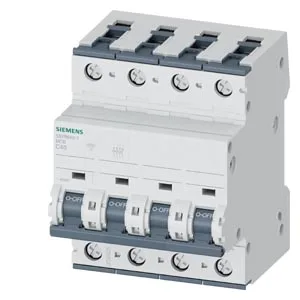
That matters when you need full isolation on a TN-S or TN-C-S system and don't want to rely on a separate neutral link. Tripping characteristic C means it holds through inrush up to 5–10× rated current before the magnetic trip fires — standard for motor-starter and light-industrial loads where a brief surge is normal but a hard fault needs fast clearing. Breaking capacity is rated 6 kA per EN 60898-1 and 10 kA per IEC 60947-2 at 400 V AC, with a DC rating of 15 kA at 60–72 V per IEC 60947-2. Under UL 1077 / CSA C22.2 No.235 it carries 5 kA. That dual-standard rating means it qualifies for both IEC distribution panels and North American supplementary-protection applications — one part for mixed-spec machines.
Snaps onto DIN rail via the quick-assembly system — 4 modular width units (72 mm wide, 90 mm tall, 76 mm deep with 70 mm installation depth). Mounting position any, so you can lay it sideways in a tight gland-plate layout without derating the thermal trip. Combined terminal top and bottom — line and load can land on either side, which saves a crossover wire when you're feeding a busbar from the bottom. Sealable, halogen-free, silicon-free — relevant if the panel goes into a food-processing or semiconductor fab where outgassing is a concern.
Ambient temperature range -40 °C to +75 °C, with humidity derating: max 95% RH at 55 °C, tapering to 35% at 75 °C. Overvoltage category III — suitable for fixed-installation distribution boards, not just downstream equipment. Energy limitation class 3 — the breaker limits let-through energy enough to protect downstream components in a fault. Rated for mechanical engineering and industry per the manufacturer's suitability designation — not a residential-grade device. Frequency 50/60 Hz, operating voltage up to 440 V AC single- or multi-phase.