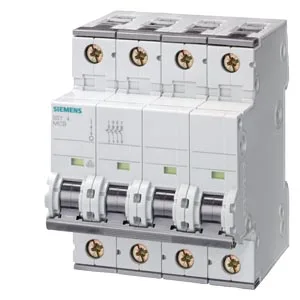
Breaking capacity is 6 kA per EN 60898 at 400 V AC, and 5 kA per UL 1077 and CSA C22.2 No. 235 — so it's rated for North American panel builds under UL 508A as a supplementary protector, not just European IEC installations. At 63 A, that's a solid 630–1260 A instantaneous magnetic trip window.
D-curve 63 A — where this fits and where it doesn't
Compared to a C-curve sibling like the 5SY4140-7 (which trips at 5–10× In and is better for general-purpose resistive and moderate inductive loads), the 5SY6663-8CC's D-curve is the right call for circuits with sustained inrush — think conveyor drives, hydraulic pump motors, or control transformers feeding a bank of contactors.
IP20 with connected conductors means the busbar and wiring provide the touch protection; the breaker body itself is finger-safe only when wired. Ambient temperature range is -40 °C to +75 °C, with derating above 55 °C: max 95% RH at 55 °C, dropping to 35% RH at 75 °C. If the panel sits near a furnace or in a refrigerated warehouse, the cold end is fine; the hot end needs the humidity derating curve applied. Vibration resistance per IEC 60068-2-6: ±1 mm at 5–25 Hz, 50 m/s² at 25–150 Hz — survives the usual machine-mounted panel shake on a conveyor line or compressor skid. Power loss is 4.9 W per pole at rated current in hot operating state — for a 4-pole unit that's 19.6 W total heat to vent inside the enclosure.