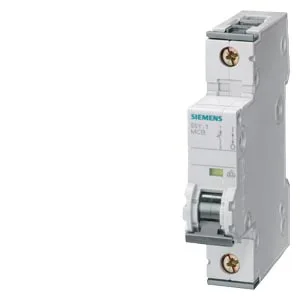
The 20 kA breaking capacity per IEC 60947-2 means this breaker can safely interrupt a fault current up to 20,000 A at 400 V without welding its contacts or cascading failure upstream. For UL 1077 supplementary protection applications (not branch-circuit rated under UL 489), the interrupting rating is 5 kA — a key distinction if the panel is destined for a North American site that requires UL-listed branch-circuit breakers. The 63 A frame is sized for a 63 A feeder or a large subfeed; at this rating the C-curve gives enough magnetic headroom to avoid nuisance trips from inrush on a group of smaller loads. The single-pole format (1P, one width unit at 18 mm) breaks only the phase — no neutral switching — so it is meant for single-phase circuits or for protecting one leg of a multi-pole distribution where the neutral is solidly bonded. Terminal capacity accepts solid or stranded conductors from 0.75 to 35 mm², with a tightening torque of 2.5 to 3.5 N·m on the screw terminals. Combined (top and bottom) terminals simplify daisy-chaining busbars or looping feed-throughs.
Deployment context and panel fit
Its 76 mm depth and 90 mm height keep it within the compact footprint of a SENTRON distribution board or a small industrial sub-panel.
The breaker carries approvals per IEC 60947-2 (20 kA) and UL 1077 / CSA C22.2 No. 235 (5 kA). The overvoltage category is III, suitable for fixed-installation distribution boards. The product designation follows DIN EN 61346-2 and DIN EN 81346-2 function code F (protective device). For compliance documentation (RoHS, REACH, CE, UKCA), Siemens typically provides a declaration of conformity and material compliance data sheets through their support portal; these are available on request with the RFQ.