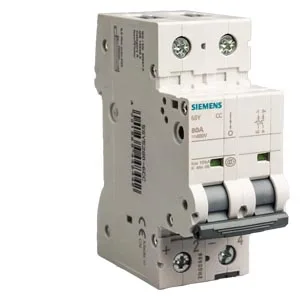
The Siemens 5SY7204-8MA is a SENTRON miniature circuit breaker with a D tripping characteristic, designed for industrial applications where high inrush currents are expected — motor starting, transformer primaries, or welding equipment. The D curve means it tolerates short-duration surges up to 10–20 times rated current before tripping magnetically, so nuisance trips on inductive loads are less likely than with a B or C curve. Rated breaking capacity is 30 kA per IEC 60947-2 at 400 V AC, which covers most industrial distribution panels up to that fault level without needing a current-limiting upstream device. The 2-pole design switches both phase conductors; neutral is not switched. Mounts in any position on a DIN rail via the quick-assembly system. This is a magnetic-only trip unit — no thermal bimetal, so it responds purely to overcurrent magnitude, not heating. That makes it suitable for circuits where ambient temperature varies widely, since the trip point doesn't drift with heat. The -40 °C to +75 °C operating range covers unheated enclosures in cold storage or outdoor cabinets.
Integration & Mounting
Occupies 2 modular width units (36 mm) on a DIN rail. Installation depth is 70 mm; overall depth with the breaker body is 76 mm. Combined terminals at top and bottom accept incoming and outgoing conductors on the same side — handy for daisy-chaining busbars or looping through to downstream loads. Sealable for lockout/tagout compliance. Supplementary devices (auxiliary switches, shunt trips, undervoltage releases) can be installed on the side. Pollution degree 3 and overvoltage category III mean it's rated for the typical industrial panel environment — conductive dust, humidity, and transient surges from upstream switching.
Standards & Compliance
Designed and tested to IEC / EN 60947-2, the standard for low-voltage circuit breakers used in industrial applications. Halogen-free and silicon-free construction matters for clean-room or semiconductor fab environments where outgassing contaminants can't be tolerated. Vibration resistance per IEC 60068-2-6: ±1 mm at 5–25 Hz, 50 m/s² at 25–150 Hz.